
Appearance
Mule Hierarchy & Defrauded Victim Shield
Engine File:
anant-engine/src/graph/MuleScorer.cpp:475-487
Structural Taxonomy: Layer 0 (Victims), Layer 1 (Collectors), Layer 2 (Distributors), Layer 3 (Terminals)
4-Tier Multi-Layer Mule Architecture
Organized financial crime does not operate in flat networks. Modern syndicates use a multi-tiered pipeline designed to insulate the masterminds from the initial theft.
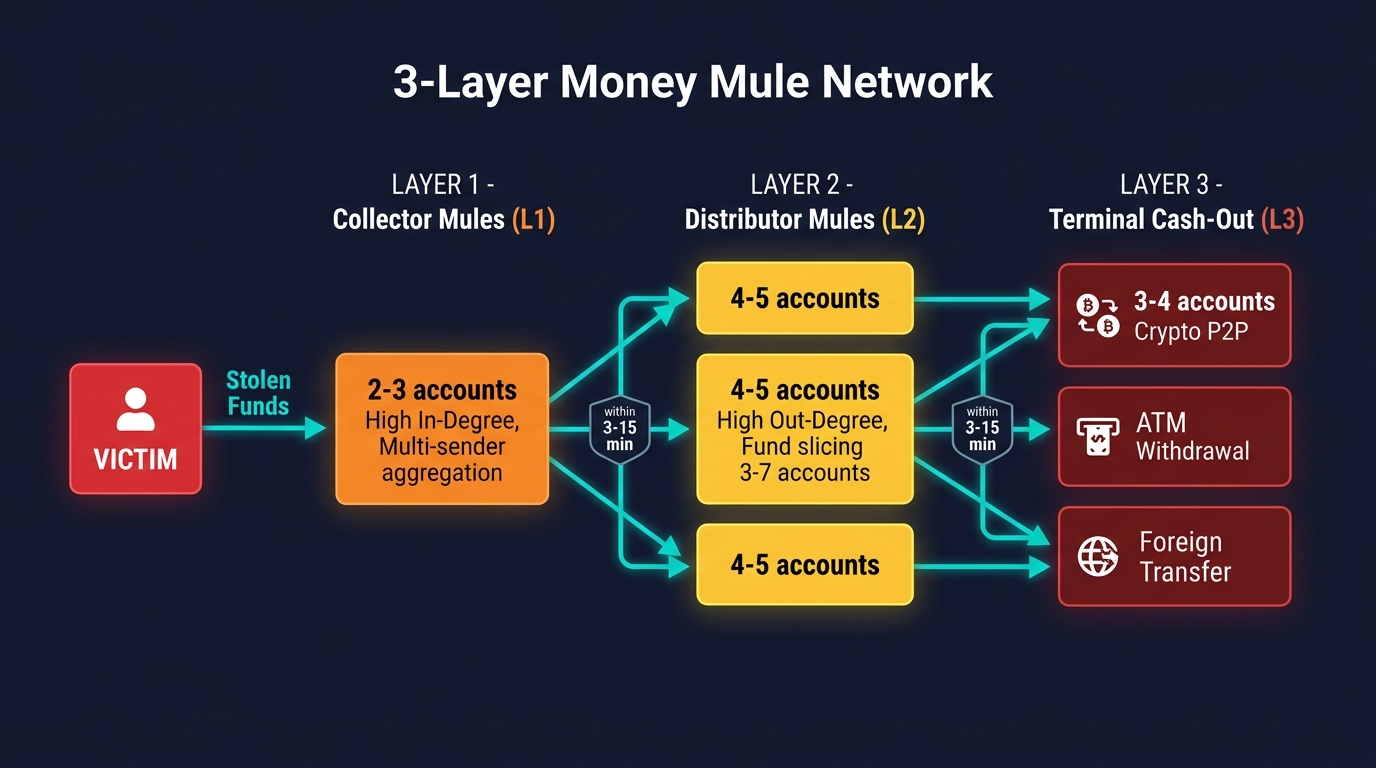
Layer Definitions & Operational Roles
Layer 0: Defrauded Victims (The Exfiltration Source)
- Role: Innocent citizens whose accounts were defrauded via phishing, APK malware, task-earning refunds, digital arrest threats, or SIM swap fraud.
- Transactional Behavior:
- Net outflow accounts (
). - Unauthorized transfers channel directly into Layer 1 collector mules.
- Zero incoming criminal funds.
- Net outflow accounts (
- The Defrauded Victim Shield (Commit
5915a2b):- The Risk: In standard AML tools, victim accounts appear to have huge single-day outflows to known fraud accounts, causing banks to freeze the victim's remaining life savings.
- The Solution: Project Anant explicitly tags victim accounts as Layer 0 and hard-caps their Mule Risk Index at
. - Legal Priority: Automatically flagged in police reports as "Priority Candidates for Immediate Bank Restitution".
Layer 1: Collector Mules (Aggregation Hubs)
- Role: Initial landing pads for stolen victim funds.
- Transactional Behavior:
- High Fan-In Ratio: Receives small to medium amounts from multiple distinct victims (
). - Rapid Consolidation: Immediately bundles funds into larger tranches and pushes them onward to Layer 2 distributors.
- Moderate to high turnover conservation (
).
- High Fan-In Ratio: Receives small to medium amounts from multiple distinct victims (
Layer 2: Distributor / Layering Mules (Smurfing Conduits)
- Role: Obfuscating the money trail through high-frequency smurfing.
- Transactional Behavior:
- High Fan-Out / Balanced Relays: Fans out consolidated funds to numerous second-tier accounts to evade single-transaction threshold reporting.
- High Temporal Velocity: Inter-transaction dwell time is typically under 15 minutes.
with , or balanced pass-through conduits ( with ).
Layer 3: Terminal Cash-Out Mules (The Exit Ramps)
- Role: Converting fiat currency into irreversible, non-traceable assets outside the banking system.
- Transactional Behavior:
- Overwhelming concentration of transactions directed to Crypto Exchanges (Binance, USDT, WazirX), P2P Merchant Desks, Hawala Escrow, or ATM Cashouts.
or . - Highest risk tier (
). - Immediate targets for bank freezing notices under Section 91 Cr.P.C. / Section 94 BNSS.
Layer Classification Algorithm
The engine classifies each account deterministically using graph structural metrics and terminal ratios:
cpp
// anant-engine/src/graph/MuleScorer.cpp
int32_t layer = 0;

if (p_terminal >= 0.5 || p_terminal_in >= 0.5) {
    layer = 3; // Terminal / Cash-Out
} else if (out_deg > in_deg * 1.5 && p_turnover >= 0.3) {
    layer = 2; // Distributor / Layering
} else if (in_deg > out_deg * 1.5 && p_turnover >= 0.3) {
    layer = 1; // Collector / Aggregator
} else if (p_turnover >= 0.5 && (n_in > 0 && n_out > 0)) {
    layer = 2; // Balanced relay conduit
}

// Explicit Defrauded Victim Override
if (is_victim) {
    layer = 0;
    mule_score = std::min(mule_score, 8.5);
}
Dataset Breakdown Across Layers
In the benchmark 2,000,000 transaction dataset (24,873 accounts):
| Layer | Classification | Account Count | Mean Mule Score | Action Required |
|---|---|---|---|---|
| Layer 0 | Defrauded Victims | 300 | 7.2 / 100 | Bank Restitution & Victim Protection |
| Layer 1 | Collector Mules | 386 | 84.3 / 100 | Trace Aggregation Hubs |
| Layer 2 | Distributor Mules | 428 | 88.6 / 100 | Trace Layering Relays |
| Layer 3 | Terminal Cash-Out Mules | 259 | 96.4 / 100 | Immediate Sec 91 Bank Freeze |
| — | Clean Citizens | 23,500 | 4.1 / 100 | Zero Action / Zero False Freezes |